Best Beginner Ski Resorts in France (2026/27 Guide)
Timeless Wanderers: Posted August 21, 2026
France is one of our favourite countries for skiing, and you don’t have to be an experienced skier to enjoy it.
Over the years, we’ve skied in many parts of the French Alps, and one thing we’ve learned is that choosing the right resort can make a huge difference when you’re learning.
A good beginner resort should give you gentle slopes where you can practise without feeling intimidated, good ski schools, easy lifts, and somewhere enjoyable to spend your time when you’re not skiing.
France does this particularly well.
Many of its larger ski areas have dedicated beginner zones, wide green and blue runs, and excellent ski schools, while the villages range from traditional Alpine towns to purpose-built resorts with everything close to the slopes.
And you don’t necessarily need to start in a small resort either. Some of France’s biggest ski areas are surprisingly beginner-friendly, giving you plenty of easy terrain while more experienced skiers in your group can explore further afield.
We’ve chosen seven French ski resorts that stand out for beginners, but each one is different.
Some are better for families, some for couples, some for learning from scratch, and others are particularly good if you want plenty of room to progress once you’ve mastered your first turns.
So before you book your first French ski holiday, let’s look at what makes a resort genuinely good for beginners and which destinations are worth considering.
Table of Contents
How to Choose the Right Beginner Ski Resort in France
For your first ski holiday, the biggest and most famous resort isn’t necessarily the best choice.
What matters more is how easy it is to learn, how close the beginner slopes are to the village, and whether there are plenty of gentle runs to move onto once you’ve mastered the basics.
I’d look for five things:
- Good beginner areas where you can practise without faster skiers flying past you.
- Easy-to-use lifts, especially magic carpets and gentle drag lifts when you’re starting out.
- A good ski school with experienced instructors who teach adults as well as children.
- Easy green and blue runs so you can gradually build confidence rather than being thrown onto something too difficult.
- A convenient village where you can easily get back to your accommodation, restaurants and ski hire without complicated transfers.
Snow conditions are worth considering too.
A resort with reliable snow and well-maintained beginner slopes can make a big difference, particularly if you’re booking early or travelling later in the season.
And don’t be too concerned about choosing a huge ski area.
As beginners, you probably won’t ski most of it anyway.
Having a comfortable learning area close to your accommodation is often much more useful than hundreds of kilometres of pistes.
With that in mind, we’ve picked seven French resorts that give beginners a good combination of easy skiing, quality instruction, convenient facilities and an enjoyable mountain experience.
Let’s start with La Plagne.
We can plan your Dream Ski Trip to Europe: Custom Itineraries for the Perfect winter Holiday.
With over 25 years of experience skiing in over 50 different ski resorts in Europe, we can help you plan your perfect winter escape.
Planning a ski trip to Europe can be exciting, but choosing the right resort and organising the perfect itinerary can quickly become overwhelming.
That’s where we come in.
We offer a personalised planning service that helps you decide exactly where to ski, based on your style, budget, and experience.
“Plus, we can help you plan a fun week of European sightseeing around your ski trip, making your winter holiday easier, smoother, and full of unforgettable memories.”
“Let us plan your perfect trip with a custom itinerary designed just for you.
Fill out the form and let’s begin your dream.”
1. La Plagne – Best Overall Beginner Ski Resort in France
If you’re looking for a French ski resort where you can learn at your own pace, La Plagne is one of the first places we’d recommend.
We’ve always liked La Plagne because it doesn’t feel as though beginners are an afterthought.
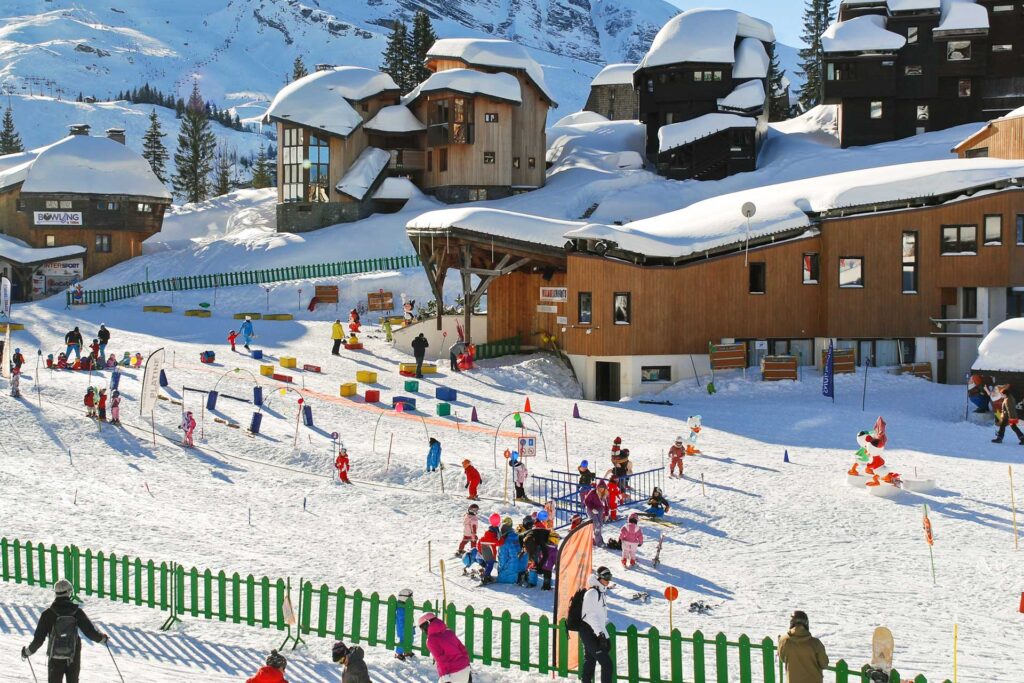
The resort has dedicated areas where you can learn away from the busier pistes, and there are gentle slopes in several of its villages.
This makes it much easier to spend your first few days concentrating on your skiing rather than worrying about getting in everyone’s way.
La Plagne’s Cool Ski areas are particularly useful for first-timers.
They are protected beginner zones with gentle slopes, learning modules and suggested routes to help you progress gradually.
There are also numerous beginner areas across the different villages, including Plagne Centre, Belle Plagne, Plagne Montalbert and Montchavin-Les Coches.
Why La Plagne is so good for beginners
One of the biggest advantages is the amount of easy skiing available once you’ve mastered your first turns.
La Plagne currently has 78 blue runs, giving beginners plenty of room to progress from the nursery slopes without suddenly finding themselves on terrain that’s too difficult.
There are also beginner lifts that are free to use in the dedicated learning areas, which is a nice bonus when you’re still figuring out whether skiing is for you.
The resort has ski schools offering both group and private lessons for adults and children, so you don’t have to try to teach yourself.
Another advantage is the choice of villages.
La Plagne isn’t one compact resort but a collection of villages at different altitudes, so you can choose the atmosphere and accommodation that suits you best while still having access to beginner skiing.
What we like about La Plagne for beginners
- Lots of dedicated beginner areas
- Gentle slopes where you can build confidence
- Excellent progression onto easy blue runs
- Ski schools for both adults and children
- Several villages to choose from
- Beginner lifts in dedicated areas
- Plenty to do once you’ve finished skiing
Our verdict:
La Plagne is our choice for the best overall beginner ski resort in France.
It combines the things that matter most when you’re learning—gentle terrain, good instruction and plenty of room to progress—with the scale and atmosphere of a proper French ski holiday.
You won’t outgrow it after your first few days either.
Once those first turns become more comfortable, there’s a huge amount of easier terrain waiting for you to explore.
Where to Stay in La Plagne -👉 Check prices and availability
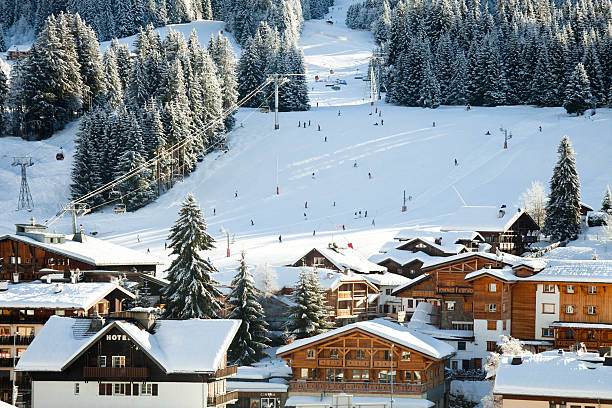
Why Les Gets is so good for beginners
The Mappys beginner area is an excellent place to start.
It has four gentle slopes, two magic carpets, a rope tow and a cable lift, giving first-timers somewhere comfortable to practise before moving further into the ski area.
Once you’re ready to progress, the Chavannes sector has wide, accessible slopes and a good selection of easier skiing.
The resort currently describes this area as particularly suited to families and learning, with the slopes leading naturally away from the village.
There is also plenty of room to continue improving.
Les Gets is connected to Morzine and the much larger Portes du Soleil ski area, so you won’t quickly run out of places to explore as your confidence grows.
You don’t need to tackle the whole area on your first trip, but it’s reassuring to know that there’s plenty waiting for you when you’re ready.
Ski lessons in Les Gets
There are several ski schools offering lessons for adults and children, including group and private tuition.
For adults, group lessons are available for all levels, with some classes limited to eight people.
That’s something we would definitely recommend taking advantage of if this is your first ski holiday.
Having an instructor show you the basics can save a lot of frustration and helps you build confidence much faster than trying to work everything out yourself.
Les Gets also has a particularly useful beginner option for adults called You Can Ski, which combines a lift pass, six half-days of group lessons and six days of equipment hire, including skis, boots, poles and helmet.
What we like about Les Gets for beginners
- Excellent dedicated beginner areas
- Wide, gentle slopes for learning
- Ski schools close to the village and lifts
- Easy access to equipment hire
- A compact village that’s simple to get around
- Plenty of green and blue runs for progression
- Direct access to the larger Portes du Soleil ski area
- A traditional Alpine village atmosphere
Our verdict:
Les Gets is our choice for the best traditional Alpine village for beginner skiers in France.
It gives you the best of both worlds: gentle, accessible skiing for learning and a beautiful village to enjoy when you’re off the slopes.
For a first ski holiday, we think that’s an important combination.
You’re not just booking somewhere to learn to ski; you’re choosing somewhere you’ll actually enjoy spending the rest of your holiday too.
Accommodation and availabilty in Les Gets
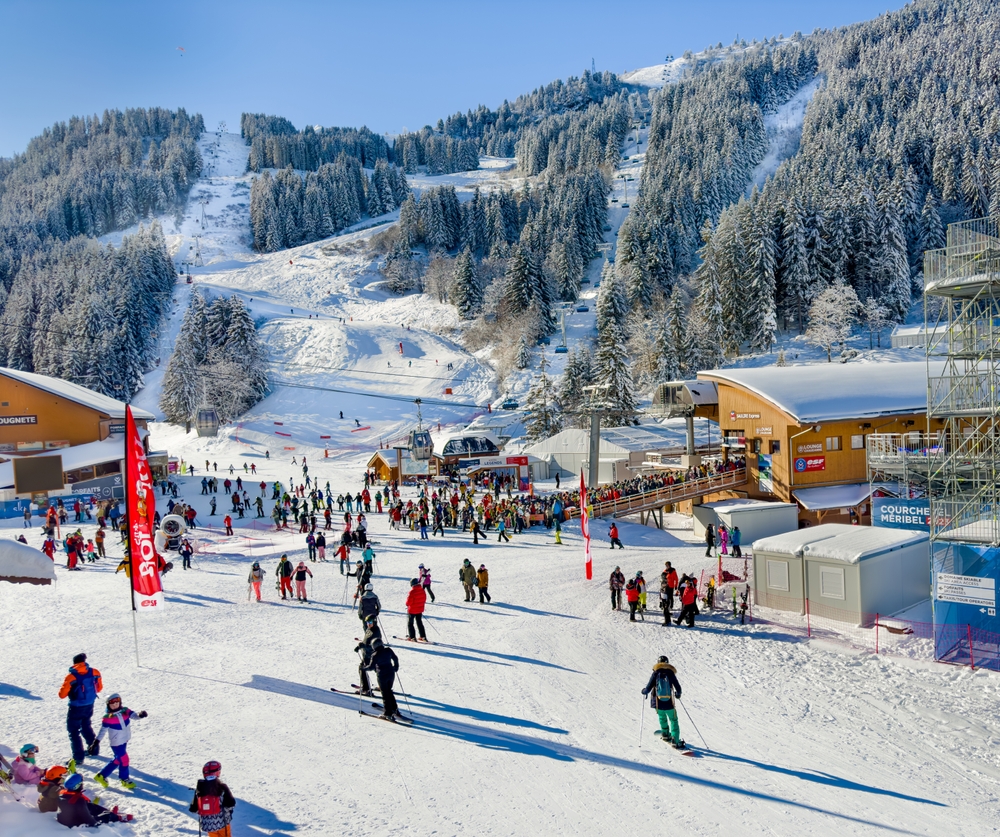
Méribel’s dedicated areas are ideal for beginners
Méribel has several dedicated beginner areas where you can get comfortable on skis before heading onto the wider mountain.
The Méribel-Mottaret and Méribel sectors both have gentle learning areas, and the resort has made a real effort to make its beginner terrain accessible and easy to navigate.
Once you’ve mastered the basics, there are plenty of easier green and blue runs where you can start putting everything you’ve learned into practice.
This is where Méribel really comes into its own.
Rather than feeling as though you’ve reached the end of the resort after learning the basics, you can gradually work your way higher and further into the Three Valleys. Méribel’s central position means you can eventually explore towards Courchevel and Les Menuires when you’re ready.
You can therefore spend your first trip concentrating on the easier slopes around Méribel and leave the more challenging skiing for another day. There’s no pressure to tackle the entire ski area just because you have access to it.
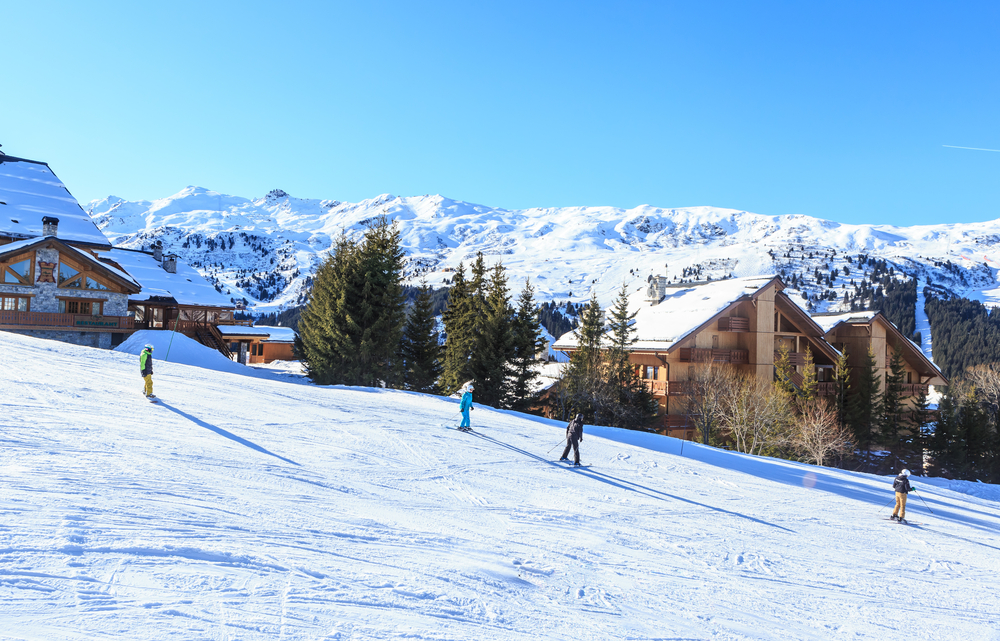
Wear a Ski HELMET, especially if you’re a beginner or in the snow parks and remember to pack your SKI GOGGLES for France.
Ski schools in Méribel
Méribel has several established ski schools offering lessons for beginners, including group and private tuition.
Lessons are available for both adults and children, and the resort has dedicated beginner zones where instructors can work with first-timers away from the more demanding pistes.
For complete beginners, we’d recommend booking lessons before you arrive, particularly during school holidays.
Having an instructor take you through the basics—how to stop, turn, use the lifts and control your speed—makes those first few days much less intimidating.
And once you’ve got the basics, don’t be tempted to rush yourself onto harder slopes.
Méribel gives you plenty of opportunities to repeat the easier runs until you feel comfortable.
What we like about Méribel for beginners
- Dedicated beginner areas
- Plenty of gentle terrain for learning
- Good ski schools for adults and children
- Easy progression from beginner areas to wider pistes
- Access to the enormous Three Valleys ski area
- Traditional Alpine architecture and village atmosphere
- Plenty of restaurants and après-ski options
- A resort you won’t quickly outgrow
Our verdict:
Méribel is our choice for the best French ski resort for beginners who want to progress.
You can spend your first few days learning at a comfortable pace, but there’s a huge amount waiting for you once your confidence starts to grow.
That makes Méribel a particularly good choice if you’re travelling with someone who already skis.
Beginners can concentrate on their lessons and easier runs while more experienced skiers have access to the wider Three Valleys—and you can gradually meet up and ski together as your confidence improves.
Where to Stay in Meribel -👉 Check prices and availability
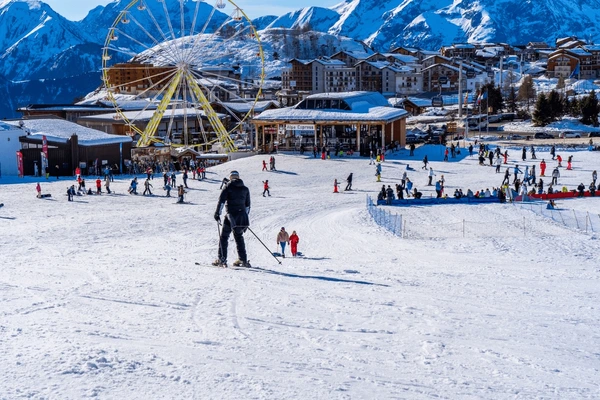
4. Alpe d’Huez – Best for Wide, Sunny Beginner Slopes
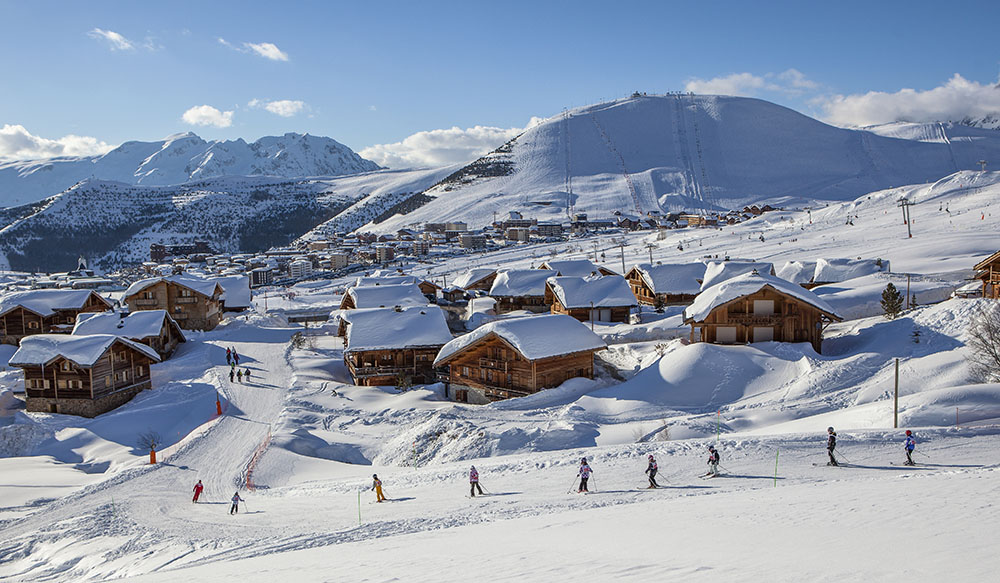
Alpe d’Huez is a resort we’d happily recommend to beginners who want plenty of space to learn and the bonus of skiing in a resort known for its sunshine.
At first glance, Alpe d’Huez can seem like an odd choice for beginners.
It’s famous for its long runs, challenging terrain and serious ski events, but there’s a much gentler side to the resort.
Beginners have their own learning areas and a good selection of easy pistes, so you don’t have to be an experienced skier to enjoy your time here.
One of the things we particularly like about Alpe d’Huez is the amount of open space.
When you’re learning, having a wide slope gives you room to practise your turns and control your speed without feeling as though you’re constantly skiing around other people.
Why Alpe d’Huez is so good for beginners
The resort has several dedicated beginner areas, including the Bergers and Huez sectors, where beginners can get comfortable before progressing further up the mountain.
There are gentle slopes and easy lifts designed specifically for people who are still finding their feet.
Once you’ve mastered the basics, Alpe d’Huez has plenty of easier blue runs where you can start exploring more of the mountain.
The transition from beginner terrain to longer pistes is one of the reasons we think the resort works so well for people who want to keep improving throughout their holiday.
And then there’s the sunshine.
Alpe d’Huez is known as “the island of the sun”, thanks to its south-facing position and reputation for sunny weather.
Of course, sunshine is never guaranteed in the Alps, but when you do get a bright bluebird day, those wide slopes and spectacular mountain views make learning to ski feel a whole lot more enjoyable.
Ski schools in Alpe d’Huez
There are several ski schools operating in the resort, offering lessons for complete beginners through to advanced skiers.
Group and private lessons are available, and the main beginner areas are conveniently located close to the resort centre.
For first-timers, we’d strongly recommend taking lessons rather than trying to learn from a partner or friend.
Skiing together sounds romantic until one person is trying to explain how to stop while the other is heading slowly towards a fence! 😂
A good instructor will teach you the basics properly and, just as importantly, help you understand how to use the lifts and move safely around the mountain.
What we like about Alpe d’Huez for beginners
- Wide, open slopes that give beginners room to practise
- Dedicated beginner areas
- Good selection of easy pistes
- Plenty of blue runs for progression
- Several established ski schools
- Sunny south-facing slopes
- Spectacular mountain views
- A large ski area that you won’t quickly outgrow
Our verdict:
Alpe d’Huez is our choice for the best beginner ski resort in France for wide, sunny slopes.
It’s a particularly good option if you want a proper high-alpine ski holiday but don’t want to spend your first few days confined to a tiny nursery area.
We’d recommend it to beginners who like the idea of having plenty of space around them and want somewhere they can continue exploring as their confidence grows.
Accommodation and availability in Alpe d’Huez
Car rental – If you plan to visit the snow, a rental car is invaluable.
5. Morzine – Best for Couples and Families
Morzine is one of those French ski resorts that makes you feel as though you’ve arrived in a real mountain village rather than simply a ski resort.
We’ve spent time skiing in this part of the French Alps, and Morzine has always stood out for its atmosphere.
The village is spread along the valley with traditional wooden chalets, restaurants, cafés and shops, while the skiing is close enough that you don’t feel disconnected from the mountain.
For beginners, that combination is a big plus.
You can spend the morning learning on gentle slopes, then finish the day with a relaxed lunch or wander through the village without needing to plan your entire day around getting back to your accommodation.
Why Morzine is so good for beginners
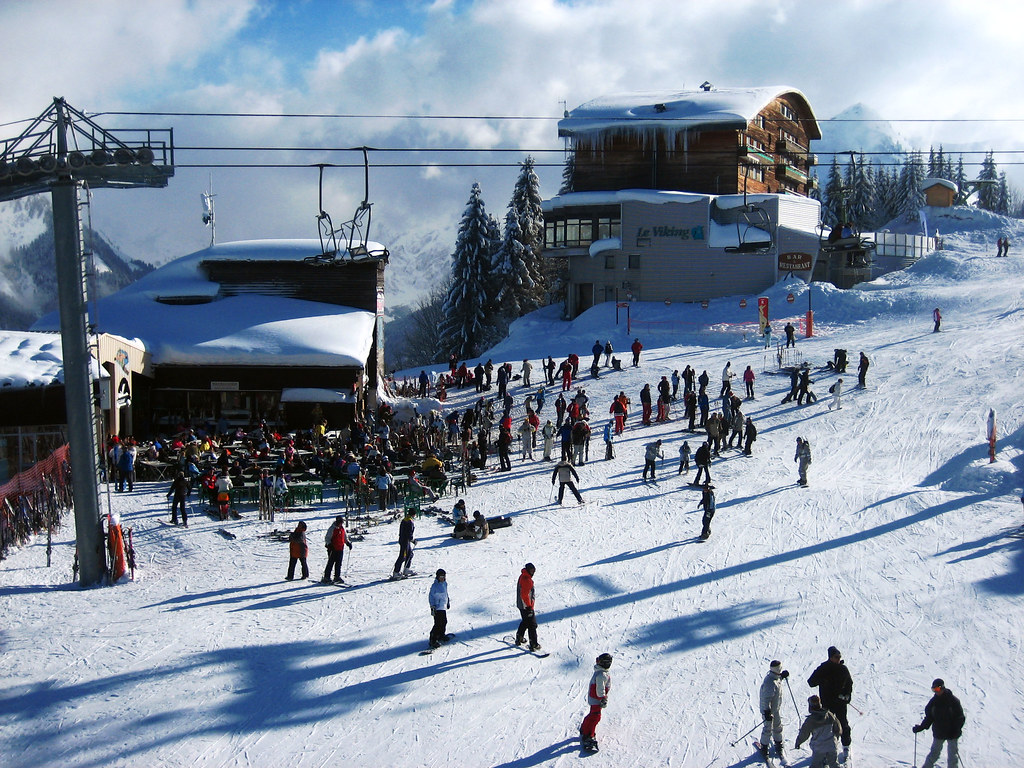
Morzine has several beginner areas close to the village, with gentle slopes and easy lifts where first-timers can learn away from the more demanding pistes.
The Pléney sector is particularly convenient, with a dedicated beginner area near the centre of the resort.
There are also beginner areas at Nyon and Les Prodains, giving you options if you want to explore different parts of the resort as your confidence grows.
Once you’re ready to move beyond the nursery slopes, Morzine gives you access to a much larger ski area.
The resort forms part of the Portes du Soleil, one of Europe’s biggest linked ski areas, stretching across France and Switzerland.
You certainly don’t need to explore all of it on your first holiday.
In fact, we’d recommend taking your time.
But having that extra terrain available means there’s plenty to discover if you return year after year.
Ski schools in Morzine
Morzine has several ski schools offering lessons for beginners, including adults and children.
Many of the teaching areas are conveniently located close to the main lifts, which makes the first few days much easier.
For complete beginners, we’d book lessons before arriving, particularly during Christmas, New Year and school holidays.
These periods can be busy, and the best lesson times can fill quickly.
We also think Morzine works particularly well for mixed groups.
If one person is learning while another is already comfortable on skis, the experienced skier has access to a much larger area while the beginner can concentrate on lessons and easier runs before joining them later in the holiday.
What we like about Morzine for beginners
- Dedicated beginner areas close to the village
- Gentle slopes for learning
- Several ski schools for adults and children
- A traditional Alpine village atmosphere
- Plenty of restaurants, cafés and shops
- Access to the huge Portes du Soleil ski area
- Good choice for families and mixed-ability groups
- Plenty to do when you’re not skiing
Our verdict:
Morzine is our choice for the best French ski resort for couples and families learning to ski.
The skiing is accessible, but it’s the village itself that really sets Morzine apart.
For us, that’s important. Your first ski holiday shouldn’t be all about getting from one lift to another.
Having somewhere pleasant to come back to at the end of the day makes the whole experience more enjoyable, especially when you’re travelling with people who may not want to ski from morning until afternoon.
Where to Stay in Morzine👉 Check prices and availability
6. Les Arcs – Best for Beginners Who Want to Explore
Les Arcs has always been one of those French ski areas we enjoy returning to.
It’s big, varied and spread across several villages, but don’t let its size put you off if you’re a beginner.
In fact, that’s one of the reasons we think Les Arcs works so well for first-time skiers.
You can start with gentle slopes close to the villages, build your confidence gradually, and then keep exploring as your skiing improves.
It’s also a resort where you’ll find plenty to do away from the slopes, which makes it a good choice if you’re travelling with people who don’t want to ski all day.
Why Les Arcs is so good for beginners
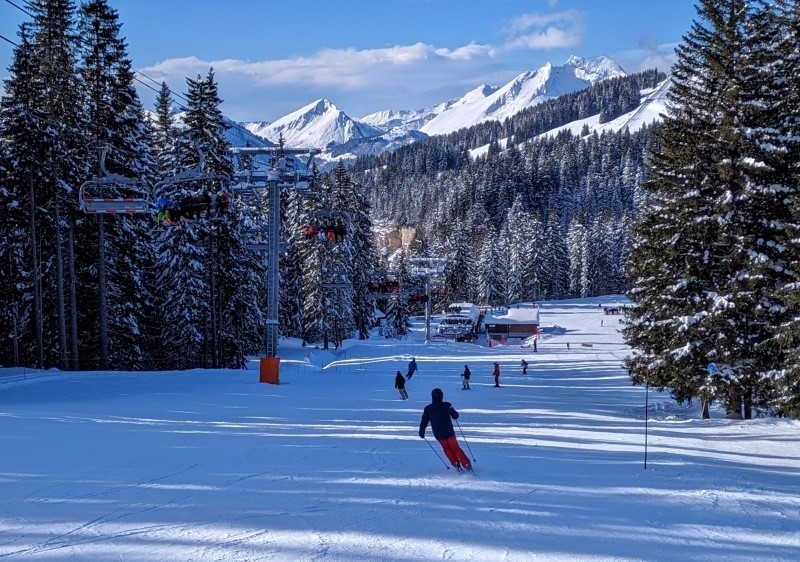
Les Arcs has dedicated beginner areas across several of its villages, so you’re never too far from somewhere suitable for learning.
Arc 1800, Arc 1600 and Arc 2000 all have beginner-friendly terrain, while Arc 1800 is particularly convenient for those who want plenty of facilities close by.
The slopes around Arc 1800 are especially useful once you’ve moved beyond the very first stages.
There are wide pistes where you can practise turns and speed control without immediately being surrounded by difficult terrain.
And because Les Arcs is such a large ski area, you won’t quickly run out of places to explore.
As your confidence grows, you can gradually move further around the mountain rather than feeling as though you’ve completed everything after a couple of days.
Skiing beyond the beginner slopes
This is where Les Arcs really earns its place on our list.
Beginners can start on the easier terrain, but there’s a huge amount of skiing waiting once you’re ready.
The wider Paradiski area, which links Les Arcs with La Plagne, gives experienced skiers an enormous choice of pistes.
You certainly don’t need to tackle Paradiski on your first morning!
But if you’re travelling with a more experienced partner or friends, they can head off and explore while you work with an instructor or practise on the easier slopes.
As your skiing improves, you can start joining them for longer runs.
That makes Les Arcs particularly appealing if you’re planning to return for more ski holidays.
You can come back the following season and find yourself skiing terrain you wouldn’t have dreamed of attempting on your first trip.
Ski schools in Les Arcs
There are several ski schools operating across the different Les Arcs villages, with lessons available for adults and children at beginner level.
Because the resort is spread across several villages, we’d recommend checking exactly where your accommodation and ski school are located before booking.
For a first ski holiday, convenience matters more than you might think.
Being able to walk a few minutes to your lesson rather than carrying skis halfway across a resort can make those first mornings much less stressful.
What we like about Les Arcs for beginners
- Beginner areas in several villages
- Wide, approachable pistes
- Good choice of ski schools
- Plenty of room to progress
- A huge range of terrain as your confidence grows
- Access to the Paradiski area
- Good choice of accommodation and restaurants
- Plenty of non-skiing activities
- Works well for mixed-ability groups
Our verdict:
Les Arcs is our choice for the best beginner ski resort in France for people who want to explore and progress.
We love the fact that you don’t have to choose between a resort that’s easy enough for a first-timer and one that you’ll enjoy returning to later.
Les Arcs gives you both.
For your first trip, take your time and enjoy the easier slopes.
There’s no prize for skiing the whole mountain.
The fun is knowing that every time you come back, a little more of Les Arcs will be within your reach.
Accommodation and availabilty in Les Arcs
7. La Rosière – Best for a Quieter First Ski Holiday
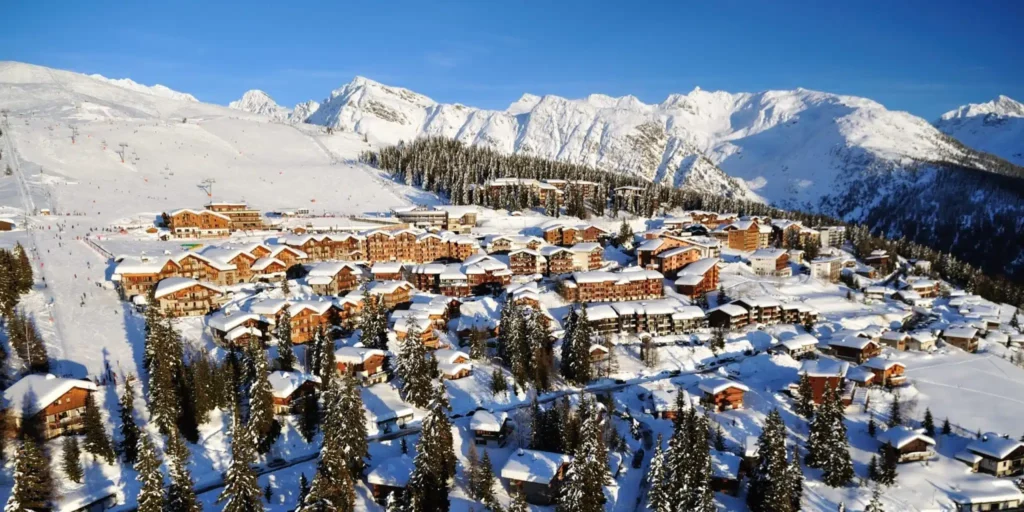
If the thought of learning to ski in one of France’s huge, busy resorts sounds a little intimidating, La Rosière could be exactly what you’re looking for.
Set high in the Tarentaise Valley near the Italian border, La Rosière has a much quieter feel than some of the better-known French ski destinations.
It’s still a proper ski resort with plenty of terrain to explore, but the atmosphere is more relaxed, which can make a big difference when you’re finding your feet on skis.
We particularly like La Rosière for people who want their first ski holiday to feel like a holiday rather than a test of endurance.
Why La Rosière is so good for beginners
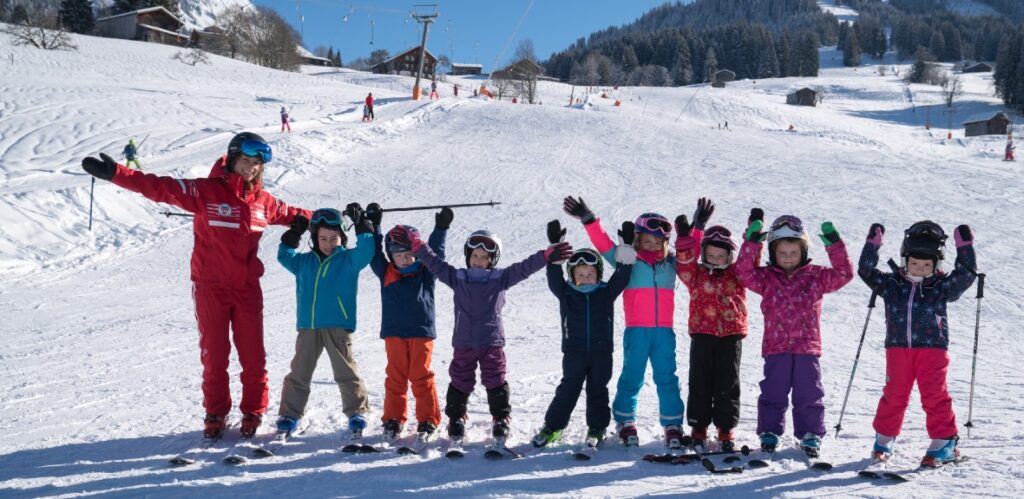
La Rosière has several dedicated beginner areas, including L’Observatoire and Les Eucherts, where first-timers can practise in relatively sheltered surroundings before progressing onto the wider ski area.
The resort also has free beginner lifts in some of its learning zones, which is a useful bonus when you’re still getting comfortable on skis.
The resort’s layout also works well for beginners.
You don’t have to spend your first few days travelling across an enormous ski area just to find an easy piste.
There are learning areas close to the main villages, making it easier to pop back for lunch or take a break when your legs start telling you they’ve had enough.
And don’t underestimate that.
Your first few days on skis can be tiring.
Being able to get back to your accommodation easily, have a warm drink and head out again later can make the whole experience much more enjoyable.
Progressing beyond the beginner slopes
La Rosière isn’t just somewhere to learn your first turns.
The resort is part of the Espace San Bernardo, linking La Rosière with La Thuile in Italy. Once you’ve gained confidence, you can start exploring further afield and even ski across the border.
For a beginner, that’s something to save for later in the holiday—or perhaps your next trip. But we like having that sense of progression built into the resort.
You can start on gentle slopes in France and eventually find yourself skiing into Italy.
That’s quite a step up from your first morning wondering how on earth you’re going to get off the chairlift!
Ski schools in La Rosière
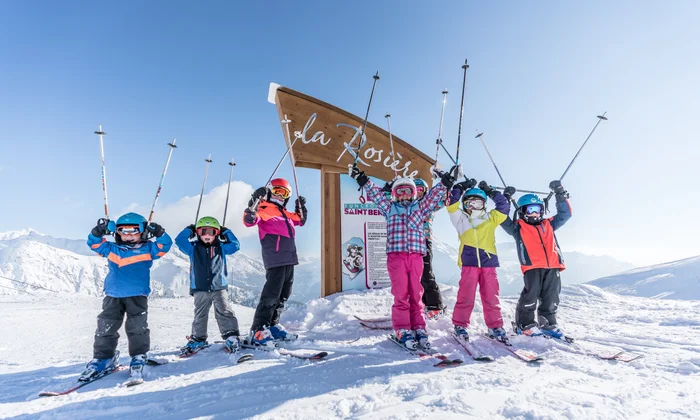
La Rosière has several ski schools offering lessons for beginners, with options for adults and children.
There are dedicated teaching areas where instructors can introduce first-timers to skiing away from the more demanding pistes.
As with the other resorts in this guide, we’d recommend booking lessons before you arrive, especially if you’re travelling during Christmas, New Year or the February school holidays.
And if you’re nervous about learning as an adult, don’t be.
Ski schools regularly teach adults who are putting on skis for the first time. There’s no age at which you’re “supposed” to have learned.
What we like about La Rosière for beginners
- Dedicated beginner areas
- Gentle slopes close to the villages
- Free lifts in some beginner zones
- A quieter, more relaxed atmosphere
- Good ski schools for adults and children
- Plenty of easy terrain for progression
- Access to the Italian resort of La Thuile
- A great choice for couples and families
- Less intimidating than some of France’s larger resorts
Our verdict:
La Rosière is our choice for the best quieter ski resort in France for beginners.
It’s particularly appealing if you’re nervous about your first ski holiday or simply don’t want to be surrounded by crowds and complicated lift connections from the moment you arrive.
We love the fact that you can start small, build your confidence and then gradually explore more of the mountain—and eventually ski across into Italy.
For a first ski holiday, sometimes having a little more space and a little less pressure is exactly what you need.
Where to Stay in La Rosiere
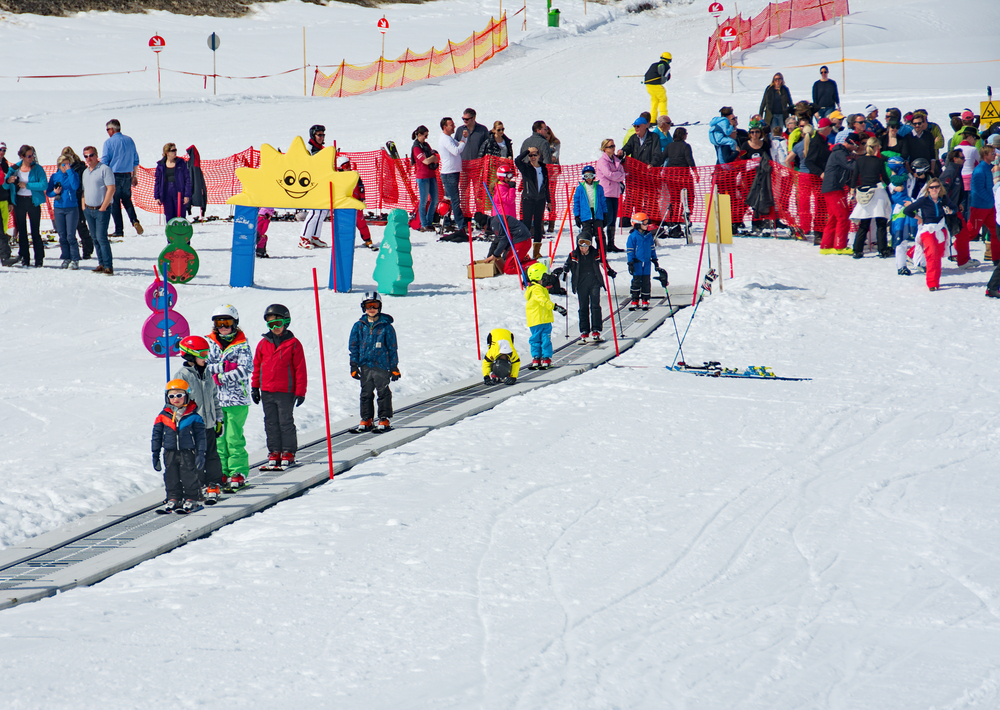
What Makes France Good for Beginner Skiers?
France is one of our favourite countries for skiing, and it’s also a great place to learn.
One of the biggest advantages is the choice.
France has everything from small, quiet mountain villages to enormous ski areas, so you can choose a resort that matches your confidence, budget and the kind of holiday you want.
Many French resorts also put a lot of thought into their beginner facilities. Dedicated learning areas, magic carpets, gentle lifts and wide green runs make those first few days much less daunting.
And once you start feeling more confident, there are usually plenty of blue runs where you can practise without immediately being thrown into difficult terrain.
The ski schools are another big advantage.
Most major French resorts have several established schools offering lessons for adults and children, and you can usually choose between group lessons and private instruction.
We’d strongly recommend lessons if you’re new to skiing.
Even if you’re travelling with someone who skis well, teaching a beginner isn’t always as easy as it sounds.
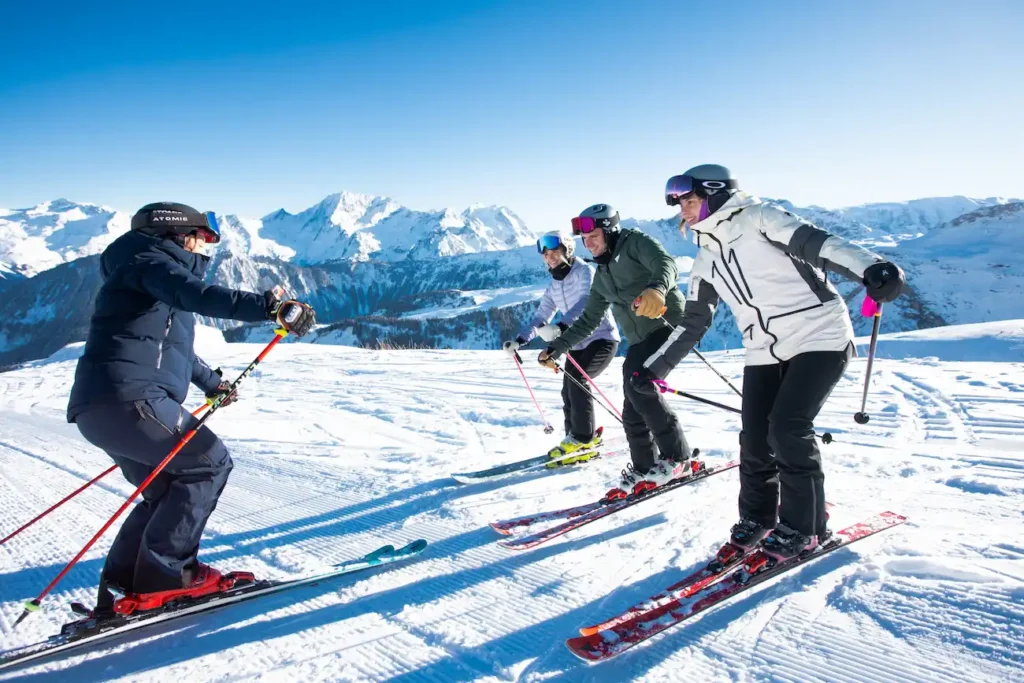
An instructor can show you the basics properly, help you understand how to use the lifts and, just as importantly, teach you how to control your speed and stop safely.
France also works well for mixed-ability groups. Experienced skiers aren’t stuck on beginner slopes all week, while beginners can learn at their own pace and gradually join the rest of the group as their confidence grows.
And then there’s everything away from the skiing.
French mountain resorts are generally very good at the part of the holiday that happens after you take your skis off.
You can have lunch in a mountain restaurant, wander through the village, enjoy a long dinner or simply sit somewhere warm with a hot chocolate and watch the snow falling outside.
For us, that’s an important part of choosing a ski resort.
Your first ski holiday should be about enjoying the whole experience, not worrying about how many runs you managed to ski.
If you’re relaxed, having fun and finishing the week more confident than when you arrived, you’ve had a successful first ski holiday.
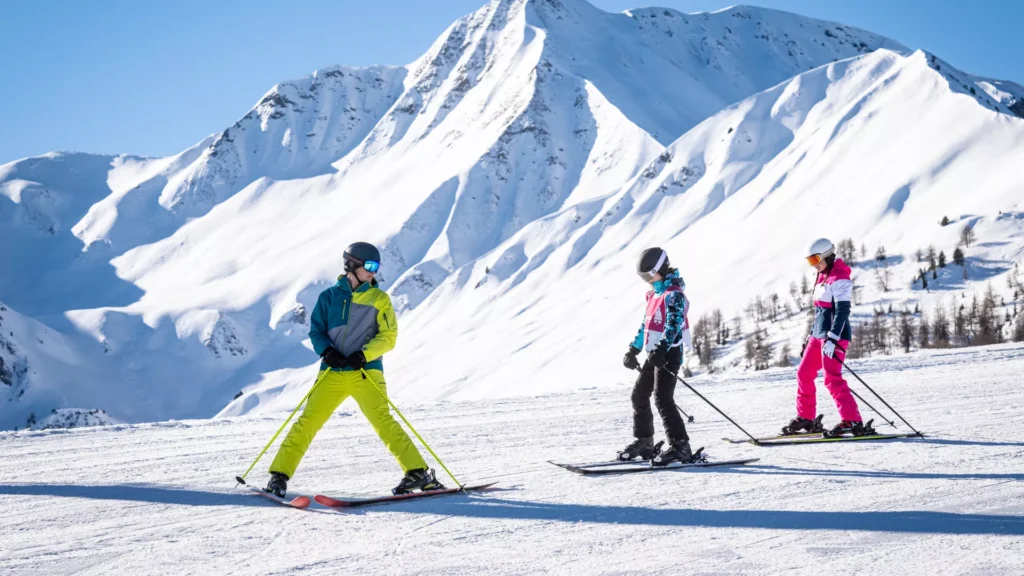
Tips for Your First Ski Holiday in France
Your first ski holiday can feel a little overwhelming.
There are ski passes, equipment, lessons, lifts, clothes, transfers and a whole new set of words to learn.
Don’t worry. Once you get through the first day or two, most of it starts to make sense.
After skiing in Europe for more than 25 years, these are some of the things we’d tell anyone heading off on their first ski trip.
Book your ski lessons before you arrive
If you’ve never skied before, lessons are one of the best things you can spend money on.
A good instructor will teach you how to stop, turn, control your speed and use the lifts safely. You’ll also learn much faster than you would trying to copy a friend or partner.
During busy periods, particularly Christmas, New Year and the February school holidays, lessons can fill up quickly, so we’d book them before your trip.
Don’t buy a complete ski wardrobe
You don’t need to spend a fortune before you’ve even discovered whether you enjoy skiing.
Good waterproof trousers and a jacket are important, but much of your specialist equipment can be hired. Skis, boots, poles and helmets are all readily available at French resorts, and hiring also means you don’t have to travel with bulky equipment.
We’d rather spend the money on good lessons and a comfortable place to stay.
Give yourself time to learn
Don’t expect to be skiing confidently by lunchtime on your first day.
The first morning is often spent learning how to stand, slide, stop and turn. Then there’s the slightly nerve-racking experience of using a ski lift for the first time.
By the second or third day, things usually start to feel much more natural.
Give yourself at least a few days rather than trying to squeeze a ski holiday into a long weekend.
The extra time allows you to improve without feeling rushed.
Don’t be embarrassed about falling
You’re going to fall.
Everyone does.
The trick is not to worry about it.
You’ll see people of every age and ability falling over on the slopes, and most skiers are far too busy concentrating on themselves to care about anyone else.
Get back up, have a laugh and try again.
Take breaks
Skiing uses muscles you probably don’t use every day, particularly when you’re starting out.
It’s tempting to think you have to ski from the moment the lifts open until they close because you’ve paid for your lift pass. You don’t.
Take a break for coffee, have a long lunch and stop for the day when you’re tired. Tired legs make it much harder to control your skis, and that’s when mistakes happen.
Choose accommodation carefully
For beginners, location can be more important than having the biggest or fanciest hotel.
Being close to the ski school, beginner slopes and lifts can make your mornings considerably easier.
You don’t want to start the day by carrying skis and boots halfway across the village before your lesson has even begun.
If possible, look for accommodation with easy access to the beginner area or a convenient ski bus.
Don’t compare yourself with experienced skiers
This might be the most important piece of advice we can give you.
You may be standing at the top of a beginner slope watching someone fly past you at what looks like 100 kilometres an hour.
Don’t worry about them.
They’ve probably been skiing for years.
Your only competition is yourself. If you can ski a little more confidently at the end of the week than you could on the first morning, you’re doing brilliantly.
Enjoy the holiday
And finally, don’t forget that you’re on holiday.
Have lunch in a mountain restaurant. Stop for a hot chocolate. Explore the village. Sit by the fire at the end of the day.
You don’t have to spend every minute on skis for it to be a great ski holiday.
For us, some of the best memories from years of skiing have nothing to do with how many runs we managed in a day. They’re the meals, the villages, the mountain views and the time spent together.
That’s what makes a ski holiday special.
Car rental – If you plan to visit the snow, a rental car is invaluable.
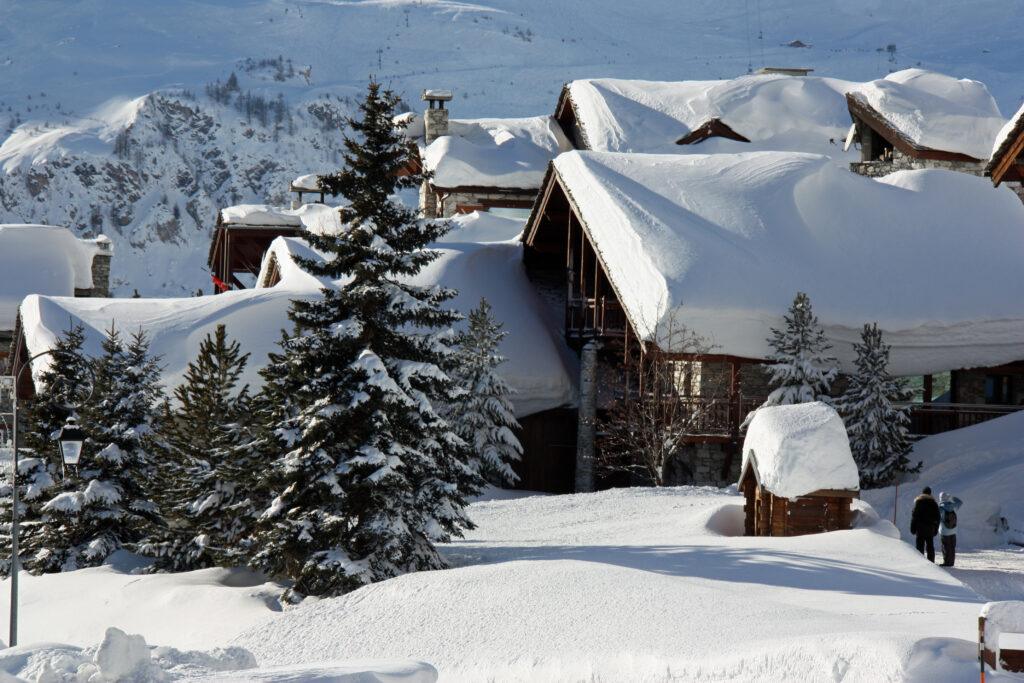
Read Our full Guide
7 Prettiest Ski Resorts in France: Alpine Charm and World-Class Slopes
How Many Ski Lessons Should a Beginner Take?
If you’ve never skied before, you might be wondering how many lessons you actually need.
Our advice is simple: give yourself at least three days of lessons, but five or six days is even better if you have the time.
Most French ski schools offer beginner courses over five or six days, with lessons usually lasting around two to two-and-a-half hours each morning.
Some also offer shorter three- or four-day programmes, which can work well if you’re taking a shorter holiday.
For a complete beginner, we’d choose the five- or six-day option if possible.
Why a full week of lessons can make such a difference
The first lesson is often about getting used to the equipment and learning the absolute basics: how to stand on your skis, slide, stop and make your first turns.
It can feel strange at first.
By the second and third days, you’ll usually start feeling more comfortable, and your instructor can begin working on your technique and helping you use the lifts and easier slopes.
By the end of a five- or six-day course, you should have had enough time to practise what you’ve learned and start building some confidence.
You may not be skiing down every run in the resort, and that’s perfectly fine. The goal is to finish your holiday feeling comfortable and wanting to ski again.
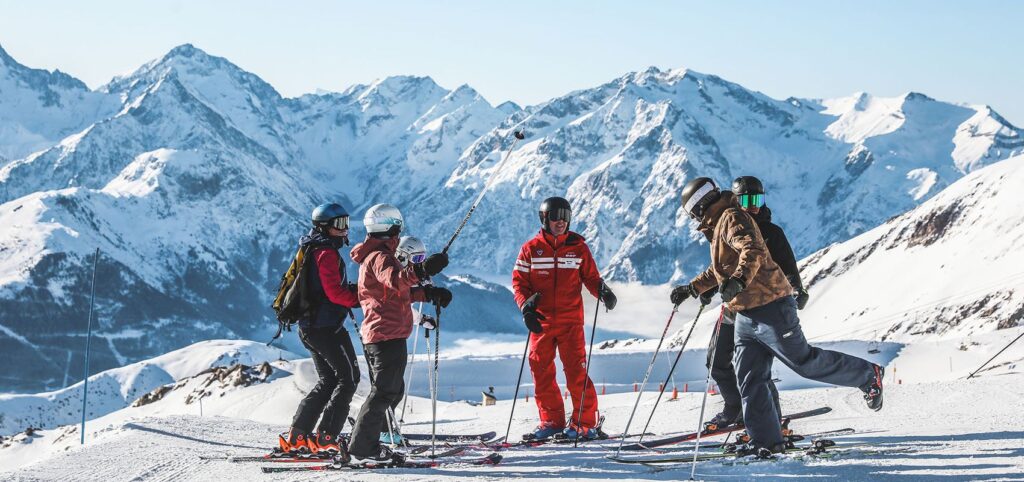
Group or private ski lessons?
For most beginners, group lessons are a great place to start.
You’ll be with other people at roughly the same level, and there’s something reassuring about learning alongside others who are also trying to figure out how to stop without falling over!
French ski schools commonly offer both group and private lessons. Private lessons can be particularly useful if you’re nervous, want more individual attention, or simply prefer to learn at your own pace.
If you’re travelling as a couple, don’t automatically assume you should teach each other.
We’ve seen enough ski trips to know that this can become frustrating very quickly!
An instructor has the experience to explain things properly and spot small mistakes before they become bad habits.
Do you need lessons every day?
Not necessarily.
If you’re only going for three or four days, we’d probably take lessons on each day you can.
If you’re staying for a week, you could take five days of lessons and then spend the final day practising what you’ve learned with your partner or family.
The important thing is not to stop lessons too early because you feel you’ve mastered the basics.
There’s a big difference between being able to slide down a gentle slope and feeling confident enough to control yourself when the piste gets busier or steeper.
Our advice for first-time skiers
If this is your first ever ski holiday, we’d recommend:
- 3 days of lessons: A good minimum if you’re on a short trip.
- 5 days of lessons: Our preferred option for a normal week-long holiday.
- 6 days of lessons: Ideal if you want to spend the whole week learning and progressing.
- Private lessons: Worth considering if you’re nervous or want more individual attention.
And don’t worry if you don’t progress as quickly as someone else in your group.
Everyone learns differently.
Some people are comfortable on skis within a couple of days, while others need longer before they feel relaxed. There’s no race, and there’s certainly no prize for getting down a blue run before your partner!
Our biggest piece of advice is to give yourself time.
Learning to ski is much more enjoyable when you’re not putting pressure on yourself to master everything in the first two days.
By the end of your holiday, if you can stop, turn, use the lifts and ski a few easy runs with confidence, you’ve done brilliantly.
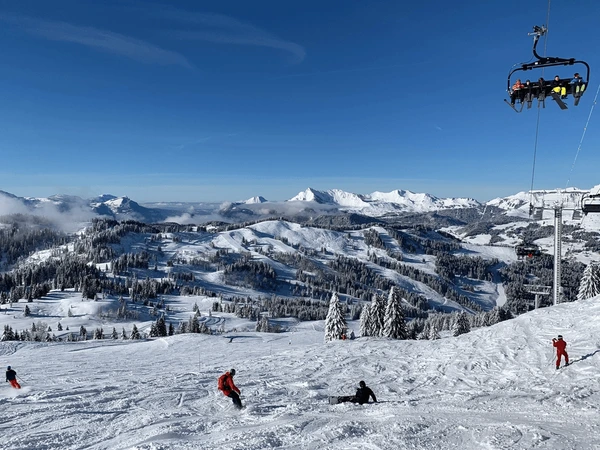
Best Time to Learn to Ski in France
Choosing when to go skiing can make a surprisingly big difference when you’re a beginner.
You want good snow, manageable crowds and enough daylight to enjoy yourself, but you don’t necessarily need to travel during the most expensive weeks of the season.
For us, January and March are two of the best times for a first ski holiday, depending on what matters most to you.
January – Our Pick for Quieter Slopes
January is one of our favourite times to ski in France, particularly once the Christmas and New Year rush is over.
By early January, the holiday crowds have usually disappeared, and the period from around mid-January to early February can be much quieter than the February school holidays.
Snow conditions are generally good, although we’d still choose a higher-altitude resort if snow reliability is a major concern.
For beginners, quieter slopes are a real advantage.
You have more room to practise your turns, shorter lift queues and less pressure when you’re still figuring out how everything works.
The downside is that January can be cold, and the days are shorter than later in the season.
So pack warm layers and don’t be surprised if you decide that a long lunch is just as important as another run!
February – Great Snow, But Watch the School Holidays
February is a popular month for skiing in France because snow conditions are generally dependable and the days are beginning to get longer.
The problem for beginners is that February can become very busy, particularly during the French school holidays.
For the 2026/27 season, the main French winter holiday period runs from 6 February to 6 March 2027, so accommodation and ski lessons can be more expensive and the slopes considerably busier during these weeks.
If February is the only time you can travel, don’t let that put you off.
Just book well ahead and, if possible, choose a resort or village with good beginner facilities rather than somewhere where you’ll need several lifts or a bus to reach your lessons.
March – Longer Days and Plenty of Sunshine
March can be a wonderful month for learning to ski.
The days are noticeably longer, temperatures are often more comfortable and there’s usually more sunshine.
Beginners often appreciate being able to spend time outside without dealing with the colder conditions you can get earlier in the season.
The trade-off is that snow conditions can become less reliable at lower altitudes as the month progresses.
For March, we’d favour one of the higher resorts on our list, particularly La Plagne, Les Arcs or Méribel, where altitude gives you a better chance of good snow.
The other big advantage is that March can feel much more relaxed once the school holiday crowds have gone.
April – Choose Your Resort Carefully
April can still be an excellent month for skiing, particularly at higher-altitude resorts.
The sunshine and longer days are lovely, but conditions can vary considerably from one resort to another.
Lower slopes can become softer or lose snow as temperatures rise, so we’d be more selective about where we go at this time of year.
If you’re a complete beginner, we’d choose a high-altitude resort with good beginner terrain rather than simply booking the cheapest April deal we could find.
So, When Should a Beginner Go?
If we were planning a first ski holiday in France, our choices would be:
Best overall: Mid-January to early February
Best for sunshine and longer days: March
Best for snow and school holiday availability: February, outside the busiest weeks
Best for late-season skiing: April, but choose a high-altitude resort
If you have the flexibility, we’d personally aim for mid-January to early February. You get a good balance of snow, quieter slopes and generally better value before the February school holidays arrive.
And remember, the “best” time isn’t just about snow.
For a beginner, having fewer people around, easy access to your ski school and enough time to relax can make just as much difference to your holiday.
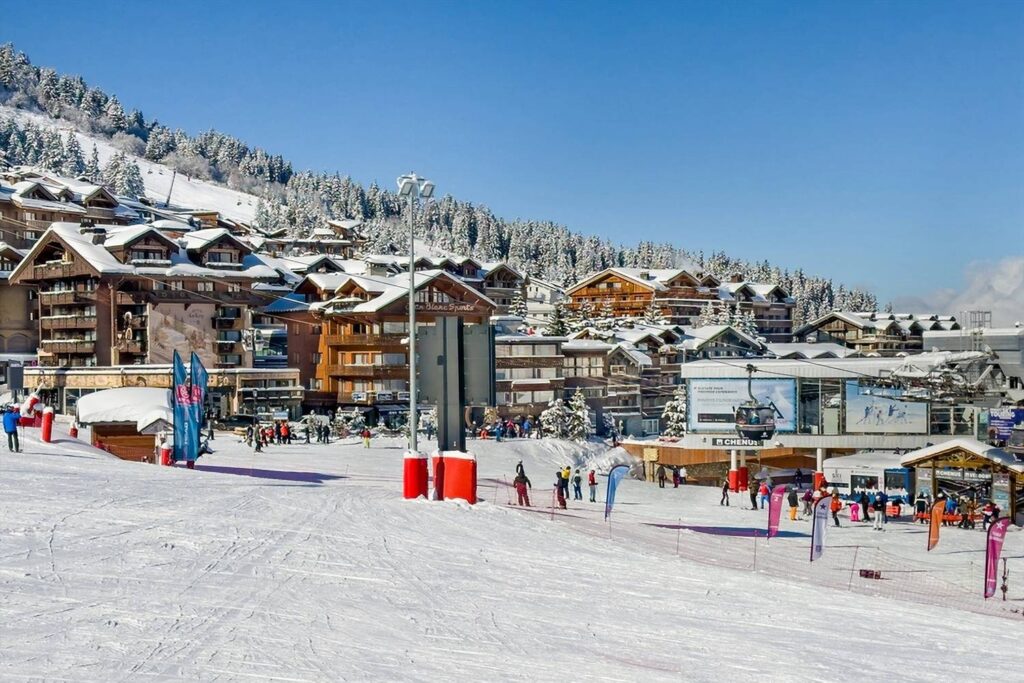
Where Should Beginners Stay in a French Ski Resort?
Where you stay can make a surprisingly big difference to your first ski holiday.
When you’re an experienced skier, you might not think twice about walking across a village in ski boots or catching a bus to the lifts.
When you’re learning, however, carrying skis, boots and poles while trying not to fall over can make a five-minute walk feel much longer!
For your first ski trip, we’d put location ahead of luxury.
Stay close to the beginner slopes and ski school
If possible, choose accommodation within an easy walk of the beginner area and your ski school’s meeting point.
This means you can wake up, have breakfast, put on your ski gear and get to your lesson without having to organise a complicated journey first thing in the morning.
It also makes returning to your accommodation for lunch or a rest much easier.
This is particularly useful during your first few days when skiing can be surprisingly tiring.
Is ski-in/ski-out worth it?
For beginners, it can be.
Being able to step outside your accommodation and onto the snow sounds like a luxury, but it can make the whole holiday much simpler.
Several French resorts have villages with ski-in/ski-out accommodation, including parts of La Plagne and Les Arcs.
However, don’t assume that ski-in/ski-out automatically means the best location.
Check exactly where the accommodation sits in relation to the beginner slopes and ski school.
Being able to ski to your door is wonderful once you’ve learned, but it isn’t much help if your first lesson meeting point is on the other side of the resort.
Should you stay in the centre of the village?
For many beginners, we think this is a very good option.
Staying in the village centre means you’ll usually have restaurants, cafés, shops and other facilities close by, which makes evenings much easier.
You can also enjoy the atmosphere of the resort without needing transport every time you want to go out.
Les Gets and Morzine are particularly good examples of resorts where the village itself is an important part of the holiday.
And remember, you’re not going to spend every minute skiing.
Some of our favourite ski holidays have involved long lunches, wandering around mountain villages and relaxing in the afternoon just as much as they have skiing.
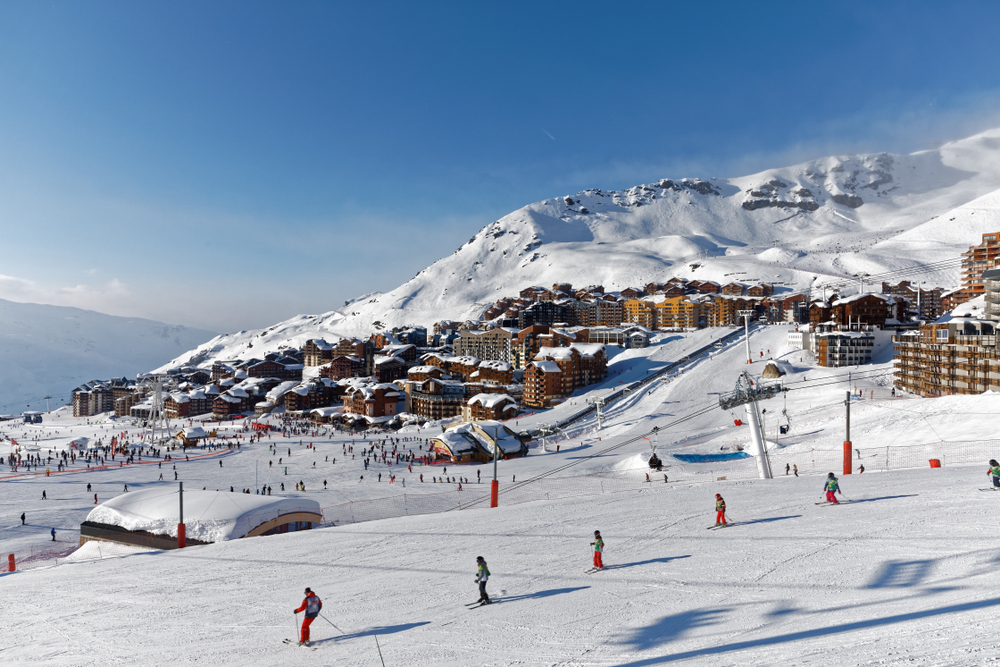
What about staying higher up the mountain?
This can work extremely well too.
Some French resorts are made up of several villages or levels, and staying higher can give you excellent access to the slopes and better snow conditions.
The important thing is to check the layout before booking.
Look at a piste map and find:
Your accommodation → beginner area → ski school meeting point → nearest lift
If those four things are reasonably close together, you’re probably onto a winner.
Our advice when booking
Before choosing your accommodation, we’d check:
- How far is it from the beginner slopes?
- Where does the ski school meet?
- Is equipment hire nearby?
- Can you walk easily in ski boots?
- Is there a ski bus if you’re not close to the lifts?
- Are restaurants and shops within walking distance?
- Can you return easily for lunch or a rest?
- Is it genuinely ski-in/ski-out, or is that just part of the marketing description?
Our biggest tip:
don’t underestimate how much easier your holiday will be when everything is close together.
When you’re learning to ski, you already have enough new things to think about.
The last thing you need is to spend your first morning trying to work out which bus gets you to ski school while carrying a pair of skis you’ve never used before!
Choose somewhere convenient, give yourself plenty of time and make the first few days as easy as possible.
That’s one less thing to worry about—and more time to enjoy learning to ski.
Where to Stay in the French Alps -👉 Check prices and availability
Frequently Asked Questions About Beginner Ski Resorts in France
What is the best ski resort in France for complete beginners?
La Plagne is our choice for the best overall beginner ski resort in France. It has dedicated beginner areas, gentle slopes, good ski schools and plenty of easy terrain to progress onto. The resort is also large enough that you won’t quickly outgrow it.
Is France a good place for a first ski holiday?
Absolutely. France has a huge choice of resorts for beginners, from traditional villages such as Les Gets and Morzine to larger ski areas such as La Plagne and Les Arcs. Most major resorts have dedicated beginner areas, ski schools and easy pistes, making it possible to learn in a comfortable environment.
Which French ski resort is best for beginner adults?
We’d look at La Plagne, Les Gets or Méribel. All three offer good beginner facilities and plenty of room to progress. Les Gets is particularly appealing if you want a traditional village atmosphere, while Méribel is a great choice if you’re hoping to continue improving and explore more challenging terrain later.
What is the easiest ski resort in France?
There isn’t one single easiest resort because it depends on what you want from your holiday. For a combination of gentle beginner terrain, ski schools and easy progression, we’d put La Plagne at the top of our list. La Rosière is another excellent choice if you’d prefer somewhere quieter and less intimidating.
How many days should a beginner ski in France?
For your first trip, we’d recommend at least three days of skiing, but a full five- or six-day ski holiday gives you much more time to learn without feeling rushed. Most beginners find that the first couple of days are about getting comfortable, with confidence building as the week progresses.
Should beginners take ski lessons in France?
Yes. We strongly recommend lessons for anyone skiing for the first time. An instructor can teach you how to stop, turn, control your speed and use the lifts properly, while also helping you build confidence. Group lessons are usually a good starting point, while private lessons can be worthwhile if you’re nervous or want more individual attention.
Is skiing in France expensive for beginners?
It can be, but it doesn’t have to be. The largest and most famous resorts can be expensive, particularly during Christmas, New Year and the February school holidays. You can keep costs down by travelling outside peak periods, hiring equipment, booking accommodation early and choosing a resort where you don’t need expensive transfers or taxis to get around.
What should a beginner wear skiing in France?
You don’t need an enormous wardrobe of specialist ski clothing. A good waterproof jacket and trousers, warm base layers, ski socks, gloves and a helmet are the essentials. Dressing in layers is useful because conditions can change quickly on the mountain. Skis, boots and poles can easily be hired once you arrive.
When is the best time for a beginner to ski in France?
For most beginners, we’d choose mid-January to early February, before the main February school holidays. The slopes are generally quieter and there can be good snow conditions. March is another excellent option if you prefer longer days and more sunshine, particularly at higher-altitude resorts.
Which French ski resort is best for a nervous first-time skier?
We’d consider La Rosière or Les Gets. Both have dedicated beginner areas and a more relaxed village feel, which can make the first few days less intimidating. La Rosière is particularly appealing if you want somewhere quieter, while Les Gets gives you the added benefit of a traditional village and easy access to a much larger ski area as your confidence grows.
Car rental – If you plan to visit the snow, a rental car is invaluable.
Our Full Guide On
“Best Family Ski Resorts in France 2025/26: Your Ultimate Guide”
Should You Get Ski Travel Insurance?
(Short Answer: YES)
While ski resorts in Europe don’t legally require you to have travel insurance, buying ski-specific travel insurance is one of the smartest decisions you can make.
Mountain travel comes with real risks — from injuries on icy slopes to delayed flights, lost luggage, or damaged ski gear.
One accident or missed connection can cost far more than a full year of coverage.
If you want peace of mind on and off the mountain, ski travel insurance is essential.
As a traveller and skier myself, I’ve consistently found SafetyWing offers some of the best winter-sports coverage for international ski trips.
Best Ski Travel Insurance Companies for 2025/26
Two companies consistently stand out for skiers, each for different reasons.
1. SafetyWing
(Best for Long-Term Ski Travel & Affordability)
We personally use SafetyWing, and have since 2019.
It’s perfect for skiers spending multiple weeks or a whole season abroad.
You can get a Quote here.
When my wife broke her ankle skiing in Wengen, they were fantastic, they paid for all our expenses without any delay.
2. World Nomads
(Best for Adventure Coverage)
If you’re planning a trip that includes off-piste skiing with a guide, winter hiking, or multiple snow sports, World Nomads often provides broader adventure coverage.
They’re a favourite among travellers who want all activities covered under one policy.
Even experienced skiers will tell you — it only takes one icy patch to ruin both a knee and a bank account.
Final Thoughts
Learning to ski for the first time can feel a little daunting, but choosing the right resort makes all the difference.
France has some of the best beginner-friendly ski resorts in Europe, whether you’re looking for wide, gentle slopes, a traditional Alpine village or somewhere you can continue skiing year after year.
If we had to choose just one, La Plagne would be our overall recommendation for first-time skiers. It offers an excellent balance of beginner terrain, professional ski schools and plenty of opportunities to progress as your confidence grows.
That said, every resort in this guide has something different to offer.
If you love traditional villages, Les Gets or Morzine may be perfect. If you’re looking for a quieter introduction to skiing, La Rosière is hard to beat.
And if you want a resort that you’ll enjoy returning to for years, Méribel, Les Arcs and Alpe d’Huez offer endless opportunities to improve.
Our biggest piece of advice?
Don’t worry about skiing every run on the mountain during your first holiday.
Take lessons, enjoy the mountain scenery, stop for long lunches, and celebrate every small achievement. Before you know it, you’ll be wondering where to book your next ski trip.
For us, that’s the real magic of skiing.
It isn’t about how many kilometres you ski or how difficult the runs are.
It’s about spending time in the mountains, enjoying beautiful Alpine villages and creating memories you’ll still be talking about years later.
We hope this guide helps you find the perfect French ski resort for your first adventure on the snow.
See you on the slopes!
PLAN YOUR SKI ADVENTURE
Booking a ski trip involves a range of reliable resources to ensure a smooth and enjoyable experience. I have listed below our favorite companies we use when we plan our ski holiday.
BOOK YOUR FLIGHT – GOING is a great search engine if you are flexible about your travel destination and dates. GOING is our new go to.
Booking.com– for accommodation, we rely on Booking.com for its extensive options and user reviews. We find they have the cheapest rates and offer payment options. In addition, VRBO is another terrific website for all types of accommodations.
Train Travel– to European ski resorts is convenient and scenic, popular trips include Glacier express to Zermatt, the Eurostar from London to the French Alps. We find Omio or Rail Europe are the best sites for booking trains in Europe.
Car Hire – we usually hire a car it offers us flexibility and convenience, allowing easy access to most resorts. Companies like Discover Cars or Rentalcars.com provide reliable options with winter equipment.
Travel insurance– Don’t ski without it. If you get hurt on the mountain it could cost you a small fortune if you’re not insured. We use SAFETYWING when my wife broke her ankle a few years ago in Wengen they were terrific.
Ski Equipment. – Bring your own ski gear, its usually cheaper and much better than renting, it ensures you have a perfect fit. Owning also saves time and money in the long run. Equipment like Skis, Pants and Jackets, Gloves, Ski-helmets and Thermal underwear” can all be bought online. You can purchase everything you need from BACKCOUNTRY
ARC’TERYX – is a go to reliable brand for outdoor adventure and travel, their wide range includes light weight durable, easy to clean travel gear.
Check out our RESOURCE PAGE for more additional planning.